
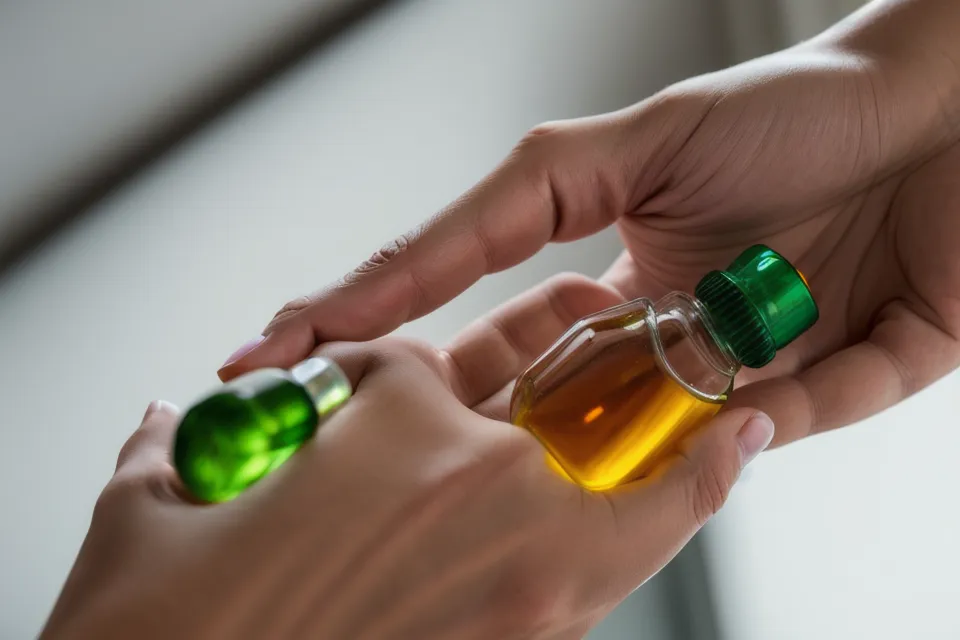
Fourteen ingredients were printed on the back of the bottle, and I could tell you what maybe two of them actually did. I was standing in my sunroom, late afternoon sun catching the amber glass and throwing a warm stripe across my desk, squinting at type clearly not sized for anyone over forty. This is where most of my reading happens now, close enough to reach a bookcase of paperbacks I've annotated within an inch of their lives, and even there, decoding an eye supplement label felt like grading an essay written in a language I never studied. Aging vision does that to you. One year you're reading Milton without a second thought, the next you're standing under good light wondering whether macular health and presbyopia are two different problems or the same one wearing different clothes.
By the time I retired from teaching, I owned four pairs of reading glasses and a running grudge against small print. My eye doctor had mentioned macular health during a routine exam, almost in passing, and it lodged in my brain the way an offhand comment from a student sometimes does. Presbyopia was the actual term for what was happening to me, though nobody said it out loud in that appointment; I found it later, on my own, looking things up instead of sleeping. Knowing the word didn't fix anything. It just gave the problem a name.
Reading the Eye Supplement Label Instead of Guessing
Here is the thing about eye supplement labels: they're written for people who already know what Lutein, Zeaxanthin, and Meso-zeaxanthin do, not people trying to figure it out standing in a store aisle. All three are carotenoids, plant pigments the body can't make on its own, and they show up in nearly every eye formula worth a second look. I won't pretend to unpack the full science of Meso-zeaxanthin and aging vision here; I wrote a longer piece on that specifically, because it's the ingredient cheaper bottles quietly leave off the list. What I can offer instead is smaller and more practical: check whether a label names all three separately, out in the open, instead of folding them into a vague "proprietary blend." If you can't tell what you're actually buying, that's the label failing you, not your reading comprehension.

None of this made me an expert. It made me a slightly more annoying customer, the kind who stands in the aisle turning a bottle over twice before it goes in the cart or back on the shelf.
Where the Centrum Senior Went Nowhere
Before I got serious about eye-specific formulas, I tried the lazy fix. I added a basic Centrum Senior multivitamin to my morning routine, mostly hoping the vitamin A in it would quietly cover whatever my eyes were missing. It did not. Weeks of taking it produced the exact same fuzzy paragraph-ends and the same dull ache behind my left eyebrow by late afternoon. A general multivitamin is built to do a hundred jobs at once, and near vision apparently wasn't high on its list that day. Deborah, my neighbor a few houses east, laughed when I told her about it; she'd tried something almost identical after watching her own mother go through the same thing at roughly my age, and landed on roughly the same nothing.
Switching to something actually formulated for eyes was a different experience entirely, though I'm wary of promising anyone else the same result. Bodies are stubborn and specific that way.
Fifty Pages at Powell's, No Lamp in Sight
Five weeks into being consistent about it, I was tucked into a corner chair at Powell's Books on Burnside with a paperback, and I got fifty pages in before I noticed I hadn't once reached over to adjust the light. Not perfect vision. Not some dramatic reversal. Just fifty ordinary pages that didn't announce themselves as a struggle until I stopped and counted them.
A reader named Glenys Aldrich emailed me not long after, and I placed the name before I finished reading the message. She wasn't writing about a problem she already had. She wanted to know what to watch for before her own vision started changing the way mine had, which is a smarter question than the one I ever asked myself at forty-eight.
That question stuck with me longer than I expected it to. Prevention isn't as dramatic as recovery, but it's the smarter play if you can get there early enough.
What I Actually Check on a Bottle Now
I also cleaned up what I was eating around the same stretch of time: less "whatever's in the fridge," more actual vegetables on the plate, on the general theory that a body running hot with inflammation doesn't hand nutrients to your eyes as easily. I wrote the fuller version of that shift beyond the kale, if you want it. Diet alone didn't fix anything, but it made the rest of what I was doing feel less like throwing supplements at a wall.

So here's what actually changed about how I shop. I stopped reading the front of the bottle at all (the promises, the stock photo of some bald eagle staring into the distance) and started reading only the ingredients panel. I look for Lutein and Zeaxanthin named individually rather than folded into a blend. I look for Meso-zeaxanthin specifically, because its absence usually tells you something about how carefully the rest of the formula was put together. And I'm wary of any label that leans harder on the marketing copy than the ingredient list, because that ratio tends to say more than either one on its own.

Talk to your own eye doctor before you start anything new. My sunroom research isn't a substitute for someone who has actually looked at your retina. But don't let a wall of unfamiliar ingredient names scare you off the label entirely. Somewhere between the fourteen ingredients I couldn't pronounce and the fifty pages I read without noticing, I got back a little of the confidence I'd lost — including, unexpectedly, driving home after dark, which nobody warns you gets tangled up in all of this too.